Ikigai for Teachers
Why are so many excellent teachers exhausted, disconnected, quietly counting down to June?

You've probably seen the diagram.
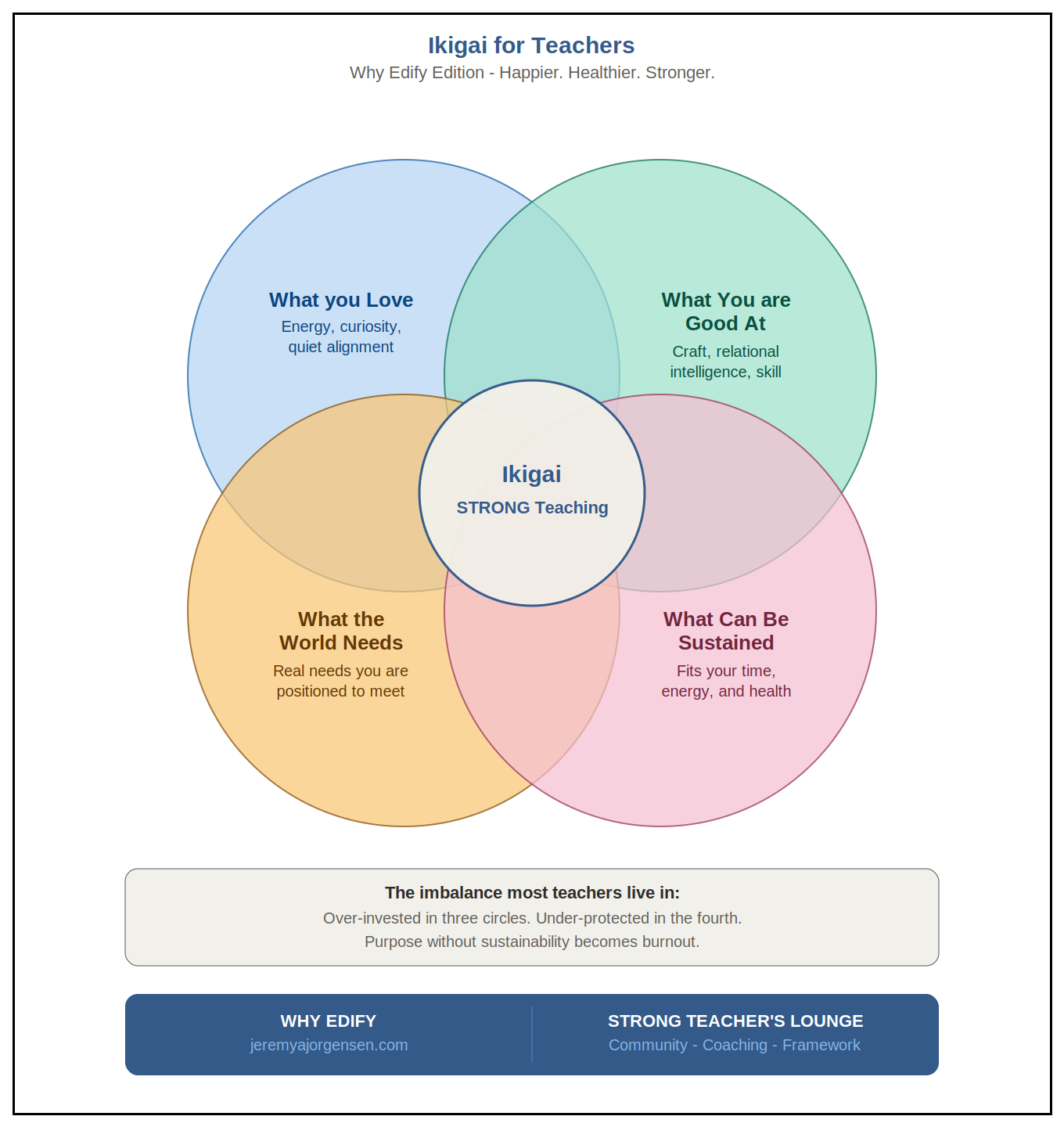
Four overlapping circles. A tidy Venn promising that somewhere in the middle — where passion, talent, purpose, and paycheck intersect — you'll find your reason for being.
It's clean. It's Pinterest-able. And for most teachers, it's almost completely useless.
Not because the concept is wrong. Because the standard version was designed for people who haven't already given everything.
The Problem With How Ikigai Is Taught
The traditional model asks you to find what you love, what you're good at, what the world needs, and what you can be paid for.
Teachers have three of those locked in before 8 am.
You love your students. You've built real skill — the kind that took years and some genuinely hard lessons. You know the world needs what you do in ways that are impossible to put a number on. You're getting paid. Not enough, but that's a different conversation.
So why are so many excellent teachers exhausted, disconnected, quietly doing the countdown to June?
The fourth circle. It's wrong for you.
What the Fourth Circle Actually Is
After completing my Ikigai coaching certification — and teaching for 27 years — I landed on a version of this framework that I think fits better.
What you love. Not passion as a constant state. That's a myth, and chasing it burns people out. This is the parts of teaching that give you energy instead of drain it. Curiosity. Connection. Creativity. The moments that remind you why you started. Quiet, steady alignment — not a daily rush.
What you're good at. Your strengths, your craft, the relational intelligence you built the hard way. Not talent you were born with. Competence you've developed, and keep developing. This pillar recognizes growth as ongoing — not something you cross a finish line on.
What the world needs. Not everything. Not everyone. The real, human needs directly in front of you — students, families, colleagues, communities — that you're uniquely positioned to meet. With integrity and care. Without trying to save the entire district.
What can be sustained with care.
That's the fourth circle. Not what you can be paid for. You already have the job. The actual question is whether you can keep teaching without destroying your health, your relationships, or your sense of self in the process.
This is the pillar that protects your longevity. And it's the one most teachers have quietly abandoned — usually framing the abandonment as dedication.
The Imbalance Nobody Talks About
Most educators are over-invested in three circles and under-protected in one.
You pour into what you love. You lean on what you're good at. You respond — constantly — to what the world needs. But sustainability? That circle either goes invisible or gets treated as selfish.
When the fourth pillar collapses, the others follow. Not immediately. Gradually. And then all at once.
Purpose without sustainability becomes burnout. Passion without limits becomes resentment. Skill without renewal becomes the kind of depletion that doesn't show up on a sick day. It shows up in how you talk about students. How you talk about Mondays.
You can love teaching and be burned out by it. Those two things aren't mutually exclusive, and pretending otherwise is how we got here. The problem isn't how much you care. It's that caring alone isn't a system.
Three More Useful Things From the Japanese Tradition
Ikigai isn't just a diagram. In its actual cultural context, it's embedded in daily practice — small, repeated habits that accumulate over time. Three concepts from that tradition deserve more than a passing mention.
Ichi-go ichi-e - means "this moment, once in a lifetime." Every interaction with your students is unrepeatable. This particular class, on this particular day, won't happen again. That sounds heavy. It's actually freeing — it means you don't have to be perfect. You just have to be present. One intentional moment per period. That's all this practice asks for.
Keiko - is intentional, repeated practice over time. Wellness isn't a retreat or a workshop or a summer of recovery (though we need those too). What actually builds resilience is small, consistent practice — the kind that compounds quietly. One of the core reasons I built the STRONG Framework the way I did is that it's Keiko in action. Not a transformation. A discipline.
Kaizen - is 1% better, not 100% different. This matters for teachers, especially because the all-or-nothing thinking is relentless. You don't need a life overhaul. You need one small thing, done consistently, adjusted over time. Built on what's already working.
One Question Worth Sitting With
Somewhere along the way, most teachers stopped asking whether this work was sustainable. They just kept going.
So here's the Ikigai reflection I come back to regularly:
Which of the four pillars am I over-relying on — and which one am I ignoring?
Most people know the answer before they finish reading the question.
The point isn't to step back from the work. It's to stop pretending that love for teaching substitutes for taking care of yourself. Your reason for being in that classroom is only as durable as the foundation holding it up.
Build the fourth pillar. The other three will hold longer because of it.
Strong Teacher Pep Talk Playlist